Object Permanence for End-to-End Autonomous Driving
1 University of Toronto 2 Automated Driving, Qualcomm Technologies, Inc
Object permanence is fundamental to human cognition, but still an open challenge for robotic systems. BeyondSight formalizes learning object permanence for end-to-end autonomous driving.
When actors are occluded, end-to-end driving models silently drop them — removing potentially critical agents from prediction and planning. BeyondSight treats object permanence as a first-class requirement: actor hypotheses persist through occlusion via temporal propagation and are fused with incoming observations. We also introduce nuScenes-Permanence, the first benchmark to supervise and evaluate occluded actors in end-to-end driving.
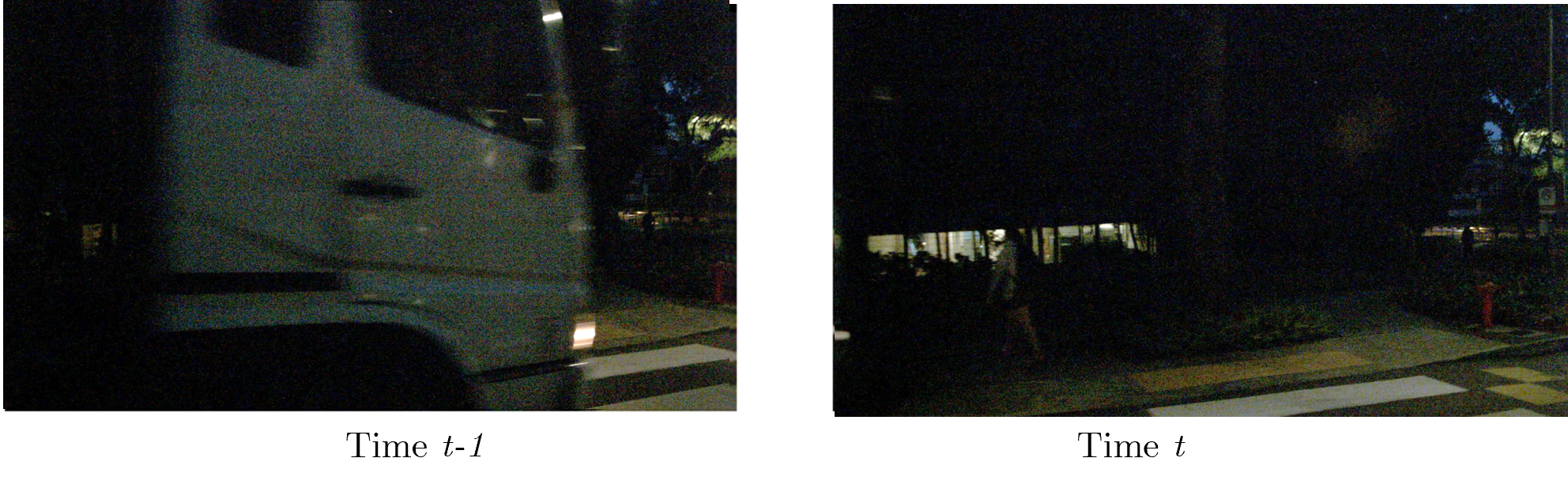
(a) Existing stacks drop actor hypotheses once occluded.
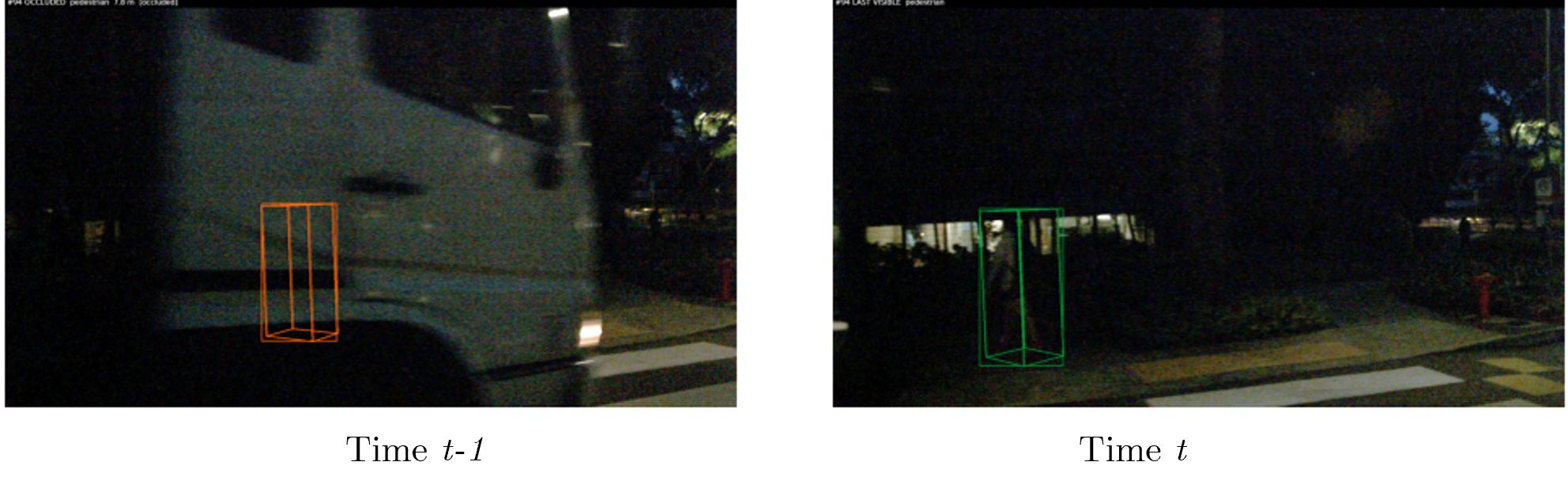
(b) BeyondSight maintains a persistent representation.
Figure 1. A pedestrian near a crosswalk becomes occluded. SparseDrive drops the actor; BeyondSight keeps it in the scene representation throughout.
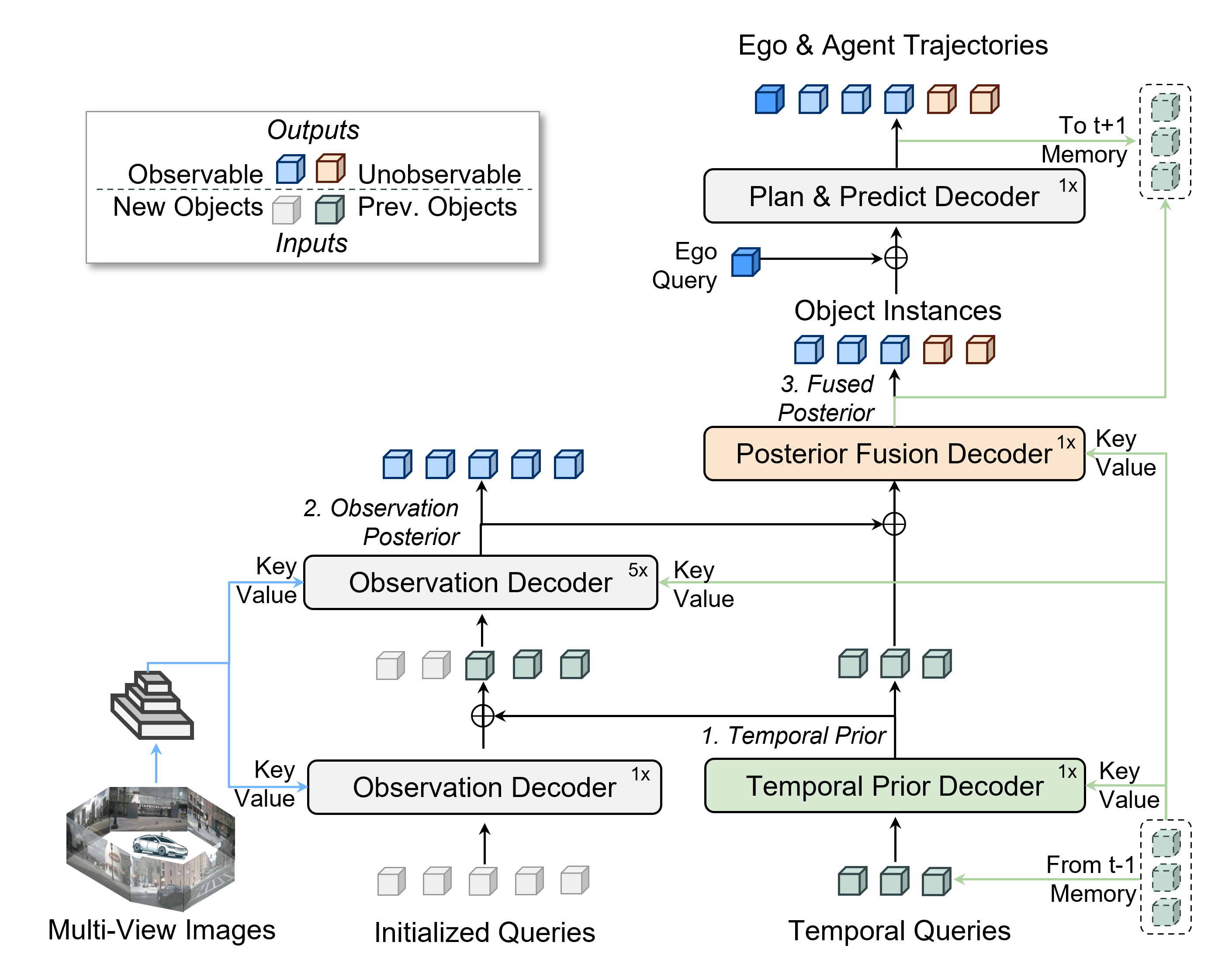
BeyondSight extends SparseDrive with a three-stage actor belief update that separates temporal propagation from observation updates — keeping unobservable actors in the scene without forcing the visual branch to hallucinate non-visible evidence. The extra decoders add <5% parameters.
Propagates actor queries using motion-conditioned self-attention — no image features. Keeps hypotheses alive during occlusion.
Combines the prior with new queries and attends to current BEV features. Supervised only on observable actors.
Merges propagated and observation-conditioned hypotheses. The unified set feeds motion prediction and planning.
Figure 2. BeyondSight overview. The three-stage actor belief update mirrors Bayesian filtering: temporal prior → observation update → posterior fusion.
Standard benchmarks penalize predictions of occluded actors as false positives — discouraging any persistence at all. nuScenes-Permanence fixes this with two contributions:
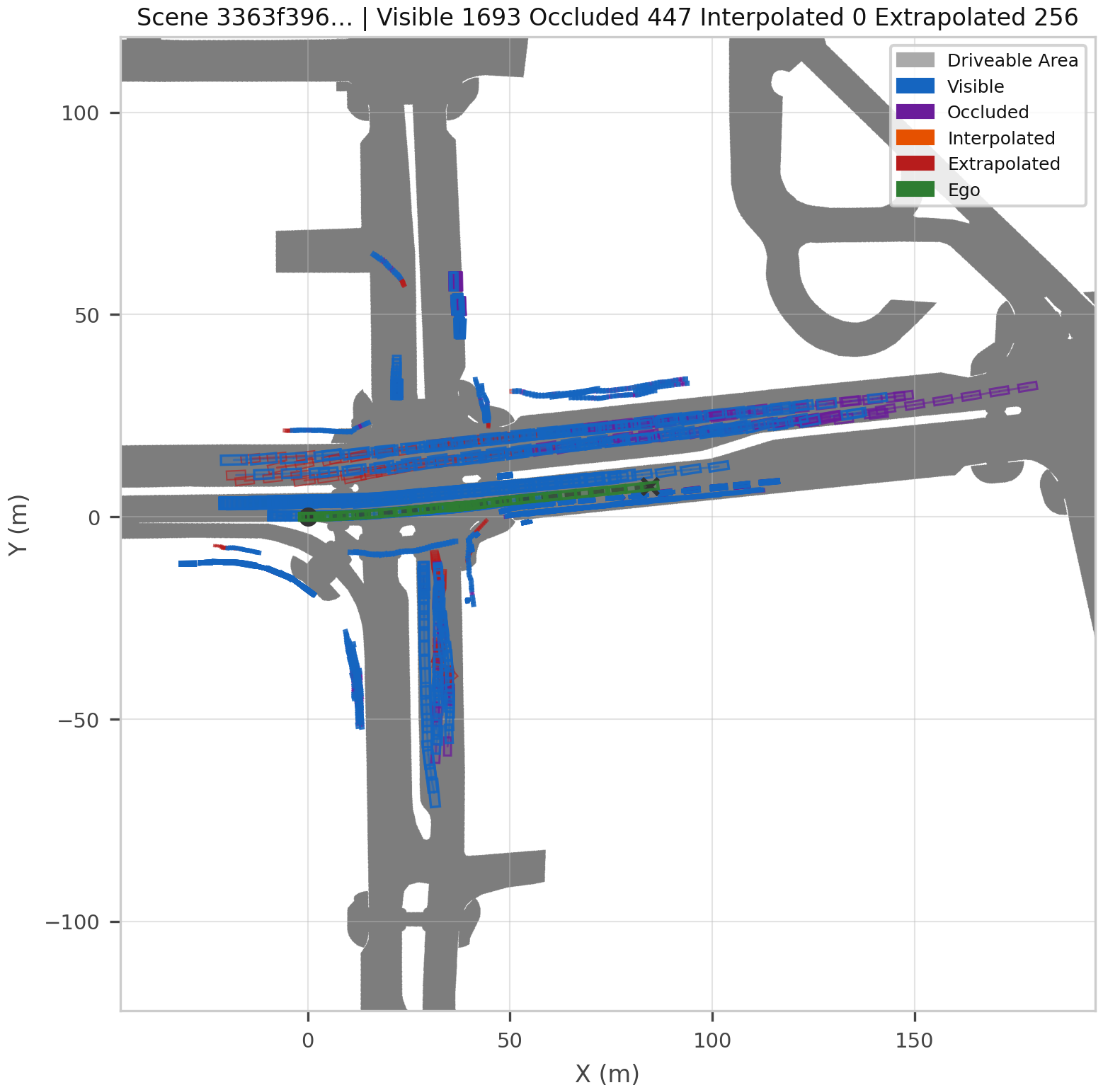
Annotation extension. Unobservable actor states are reconstructed offline via interpolation and short-horizon extrapolation, expanding nuScenes from 932k to 1.33M boxes.
Observability-conditioned evaluation. Ground truth is split into observable and unobservable subsets with symmetric ignore rules, reporting mAPobs, mAPunobs, and mAPall — preventing cross-penalization.
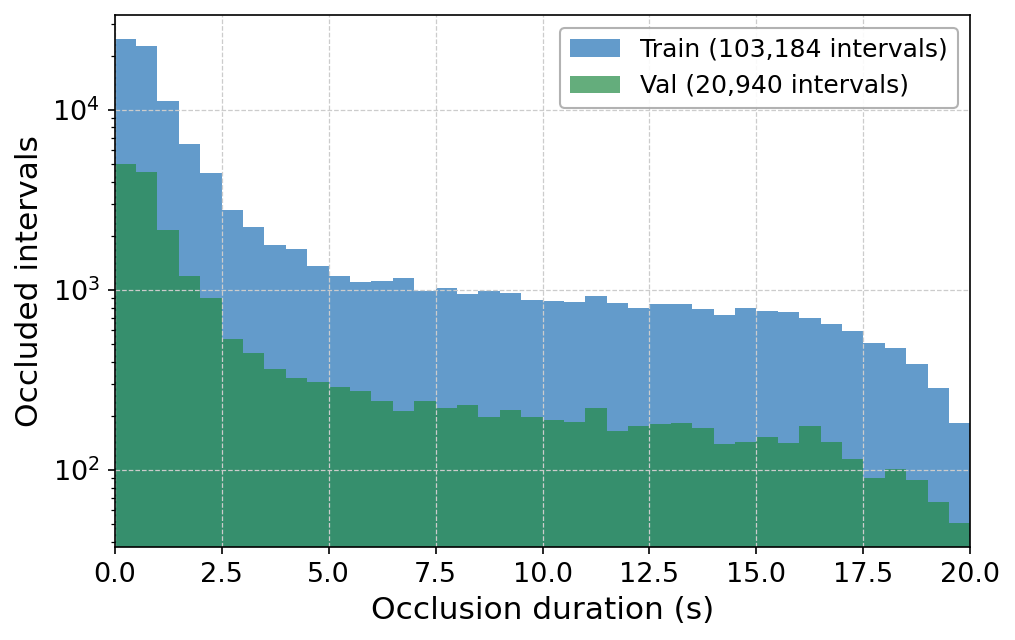
Occlusion duration distribution
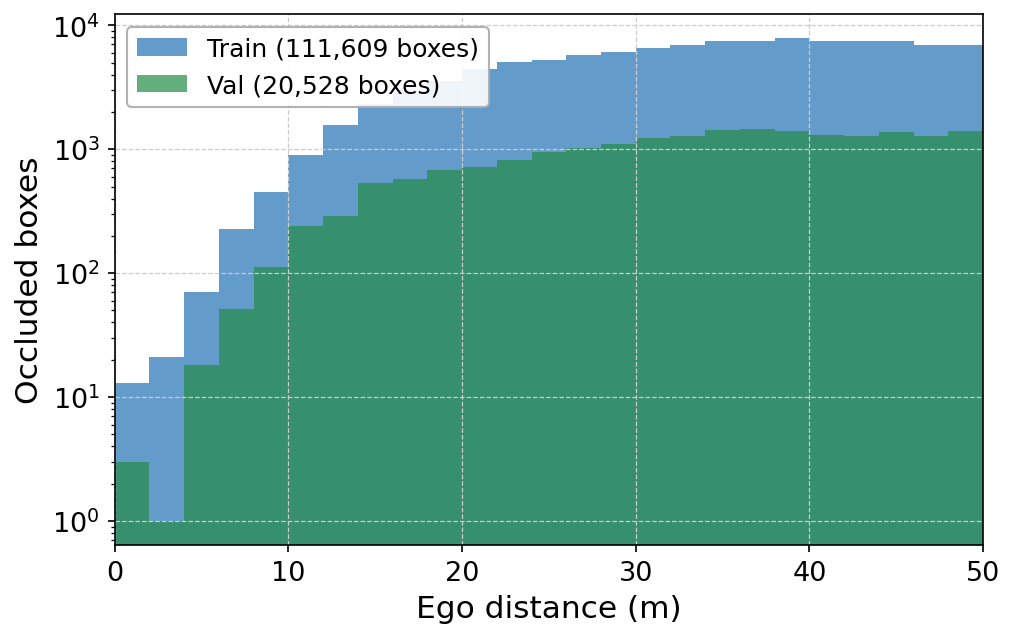
Ego distance at occlusion onset
Figure 4. Occlusion is common and close. Full-sensor absence occurs frequently across all distances — not just rare edge cases.
Figure 5. Generated annotations (zero-point, interpolated, extrapolated) across urban, intersection, and highway scenes. Boxes are colored by observability status.
BeyondSight improves across the board on standard nuScenes — and dramatically on nuScenes-Permanence — without touching the planner.
| Method | mAP ↑ | NDS ↑ | AMOTA ↑ | L2avg ↓ | CRavg ↓ |
|---|---|---|---|---|---|
| UniAD | — | — | — | 1.03 | 0.31% |
| SparseDrive | 0.415 | 0.526 | 0.372 | 0.61 | 0.08% |
| BridgeAD | 0.423 | 0.534 | 0.398 | 0.58 | 0.08% |
| MomAD | 0.423 | 0.531 | 0.391 | 0.60 | 0.09% |
| BeyondSight (ours) | 0.427 | 0.536 | 0.401 | 0.54 | 0.07% |
| Method | mAPall ↑ | mAPobs ↑ | mAPunobs ↑ | L2avg ↓ |
|---|---|---|---|---|
| SparseDrive | 0.389 | 0.415 | 0.000 | 0.61 |
| BeyondSight (ours) | 0.413 | 0.421 | 0.249 | 0.54 |
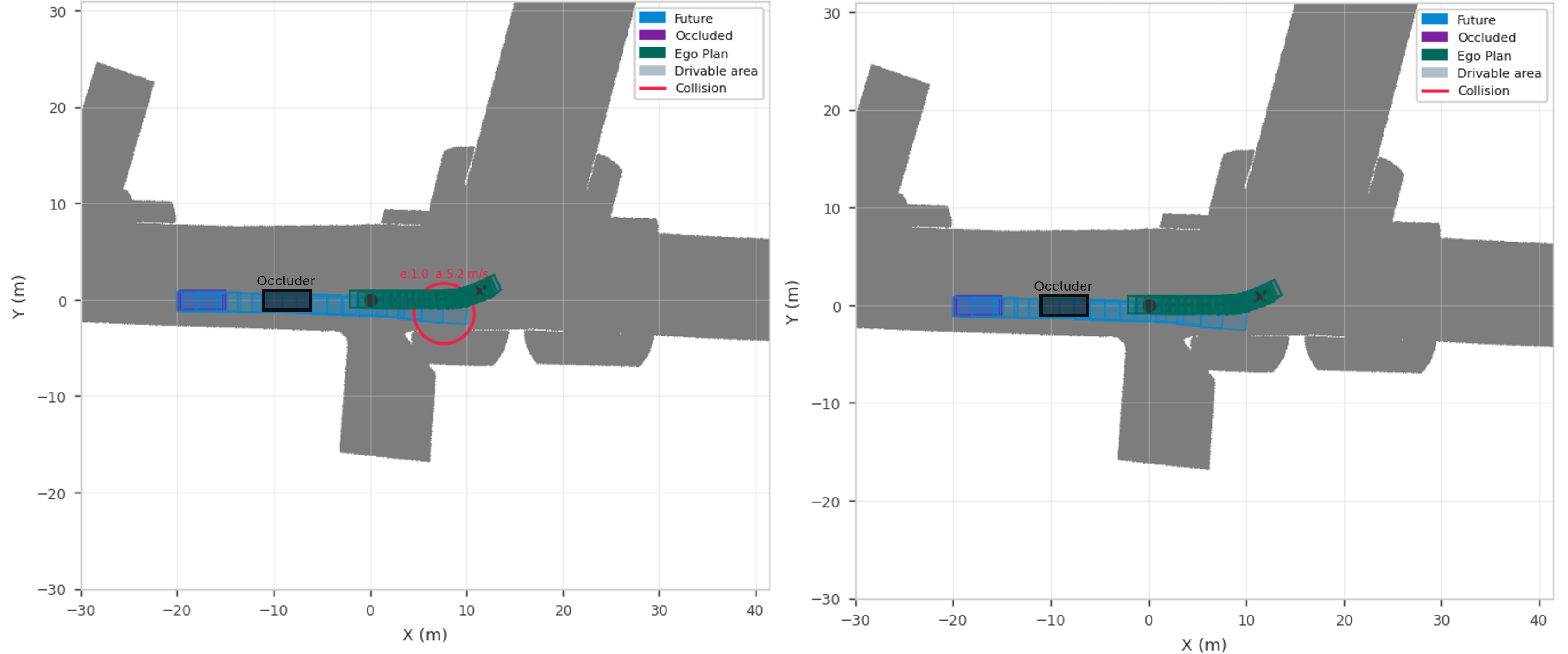
When an actor becomes fully occluded, SparseDrive drops it — and plans through it. BeyondSight maintains a persistent hypothesis and routes around it. On a high-occlusion subset, collision rate drops from 0.163 → 0.08 CRavg.
Figure 3. Left: SparseDrive drops the hidden actor and plans through its future path. Right: BeyondSight maintains the hypothesis and produces a safer trajectory.
@inproceedings{papais2026beyondsight,
title = {BeyondSight: Object Permanence for End-to-End Autonomous Driving},
author = {Papais, Sandro and Wang, Letian and Jain, Mudit and Rezaei, Behnaz and Waslander, Steven L.},
booktitle = {European Conference on Computer Vision (ECCV)},
year = {2026}
}